


Dog bites and other animal attacks can result in serious injuries. Under Illinois law, the owner of the animal is usually legally responsible for expenses connected to those injuries.
To ensure that you get the compensation you deserve from the owner when you are bitten by a dog or other animal, call the Chicago serious injuries and wrongful death lawyers at Mark L. Karno & Associates, LLC today at (312) 701-0090 for a free case consultation with our experienced injury attorneys.
Get An Experienced Attorney On Your Side
An experienced Chicago premises liability lawyer can help you understand your legal options and pursue the responsible parties in your dog bite claim. You shouldn’t have to pay for medical bills that are the direct result of someone else’s negligence in training or taking care of a dog.



Some victims of dog bites or a dog attack are hesitant in filing a lawsuit to pursue compensation because the aggressive dog was owned by a friend, neighbor or associate. In most cases, however, the dog owner is not paying for your medical expenses out of pocket. The dog owner will often have a homeowners’ insurance policy, and his or her insurance provider is responsible for reimbursing you for your medical expenses after a dog attack.

Injured by a Dog Bite?
Contact an Attorney at Mark L. Karno & Associates, LLC Today
Why You Can Trust Us with Your Dog Bite Injury Claim
- We have spent decades representing injured victims and know how to build strong cases after serious dog attacks.
- Each case receives direct attorney involvement, ensuring clear guidance and consistent communication throughout the legal process.
- Clients only pay legal fees if compensation is successfully recovered.
Most Common Types of Dog Bite Injuries
Dog attacks can produce injuries ranging from minor wounds to life-altering trauma. Common injuries include:
- Puncture wounds: Dogs have powerful jaws that can penetrate deep into the skin, creating wounds that may damage muscles, nerves, or blood vessels.
- Lacerations and tearing injuries: When a dog clamps down and shakes its head, it can tear skin and tissue, resulting in severe cuts that require stitches or surgery.
- Broken bones: Larger dogs may knock victims to the ground or clamp down on arms and legs with enough force to cause fractures.
- Infections: Bacteria in a dog’s mouth can lead to infections such as cellulitis or, in rare cases, rabies if the animal has not been vaccinated.
- Scarring and disfigurement: Many dog bite victims suffer permanent scars, particularly when bites occur on the face, hands, or arms.
- Psychological trauma: Victims may develop anxiety, fear of animals, or post-traumatic stress symptoms after a severe attack.
The severity of the injuries often depends on the size of the animal, the location of the bite, and how long the attack lasted. Children are particularly vulnerable because their height often places their faces and necks within reach of a dog’s bite. Because dog bites often involve puncture wounds and bacteria, medical attention should be sought immediately after an attack.
Who Is Responsible for Dog Bites in Chicago?
When a dog attacks someone without provocation, Illinois law generally places responsibility for dog bite injuries on the owner of the animal. Responsibility may also apply to the following parties:
- Property owners: In some cases, landlords or property owners may share liability if they knowingly allowed a dangerous animal to remain on the premises.
- Caretakers or handlers: Individuals who were responsible for supervising the dog at the time of the attack may also face liability if their negligence contributed to the incident.
Determining liability often requires reviewing the circumstances of the attack, witness statements, animal control records, and other evidence. However, Illinois follows a strict liability standard for many dog bite cases.
This means a victim does not need to prove that the dog previously attacked someone or that the owner knew the dog was dangerous. If the dog caused injuries while the victim was lawfully present and did not provoke the animal, the owner can be held responsible for the resulting damages.
Types of Compensation Available in a Chicago Dog Bite Claim
Even minor injuries in dog bite cases can result in long-term emotional suffering. More severe physical injuries, including infections or scarring from puncture wounds, can require extensive medical care. In your dog bite case, you may be entitled to recover damages for:
- Medical expenses: Emergency care, hospital treatment, surgery, medication, and follow-up care related to the injury.
- Future medical treatment: Some victims require reconstructive procedures, scar revision surgery, or ongoing therapy.
- Lost income: Compensation may cover wages lost while recovering from the injury.
- Reduced earning capacity: If the injuries affect a victim’s ability to work in the future, compensation may address that loss.
- Pain and suffering: Illinois law allows recovery for the physical pain and emotional distress caused by the attack.
- Scarring or disfigurement: Dog bites frequently leave permanent scars, particularly on the face, arms, or hands.
- Psychological trauma: Victims may also recover damages for anxiety, fear of dogs, or post-traumatic stress following the attack.
Chicago Dog Bite Injury Statistics
Illinois consistently ranks among the states with the highest number of dog bite insurance claims. In 2024, Illinois recorded approximately 940 dog bite liability claims, resulting in more than $61 million in insurance payouts. The average dog bite insurance claim in Illinois is close to $65,000, reflecting the high cost of medical care and injury settlements.
Local data also shows that dog bite incidents occur regularly in Chicago. Reports compiled from the city’s 311 complaint system identified thousands of dog bite complaints reported in Chicago over recent years, demonstrating that attacks occur frequently in densely populated urban areas.
National public health data provides additional context. The Centers for Disease Control and Prevention (CDC) estimates that approximately 4.5 million dog bites occur in the United States each year, with hundreds of thousands of victims requiring medical treatment. Children face the greatest risk of serious injury, particularly when bites occur to the face, neck, or head.
According to the Insurance Information Institute, more than 22,000 dog bite and dog-related injury insurance claims are filed each year in the U.S., resulting in more than $1.5 billion in annual insurance payouts. Dog-related injuries also account for over one-third of homeowners’ insurance liability claims nationwide.
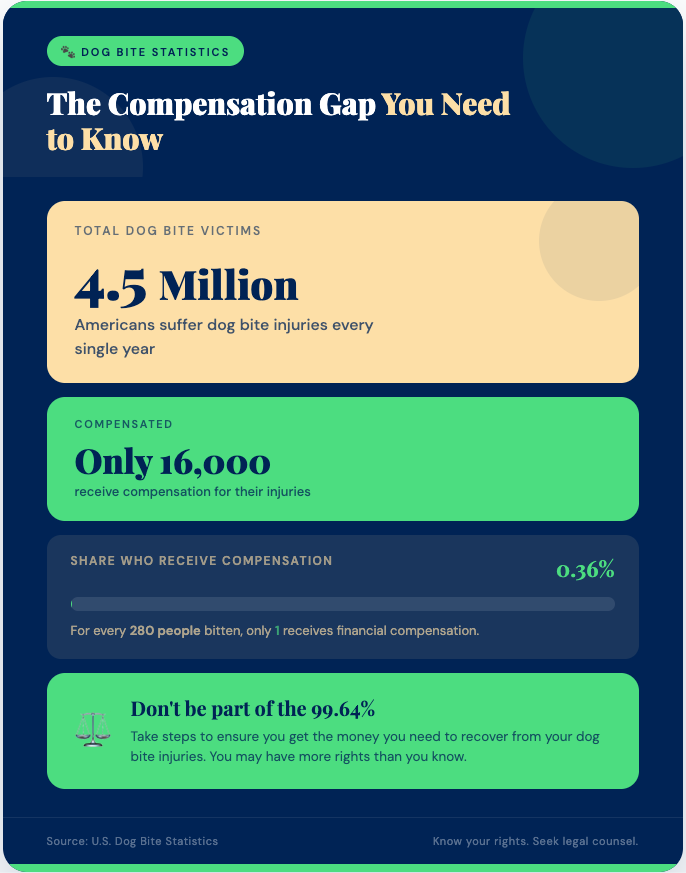
Although almost 4.5 million Americans suffer dog bites every year, only about 16,000 of those victims will receive compensation for their injuries. Take steps to make sure you get the money you need to recover from your dog bite injuries.
How Much Is My Chicago Dog Bite Claim Worth?
Dog bite claim values vary widely depending on the circumstances of the attack and the seriousness of the injuries. Some cases resolve for relatively modest amounts, while others result in substantial settlements. Several key factors often influence a case’s worth:
- Permanent scarring or visible injuries: Bites to the face, hands, or arms often result in higher settlements because of the lasting cosmetic impact.
- Age of the victim: Dog bite injuries involving children sometimes result in larger claims because of the potential for long-term physical and emotional effects.
- Strength of the evidence: Clear evidence showing that the dog attacked without provocation can strengthen a claim and increase the likelihood of a favorable settlement.
- Insurance policy limits: Many dog bite claims are paid through homeowners or renters insurance. The amount of available coverage can influence the final settlement.
- Severity of the attack: Incidents involving multiple bites or prolonged attacks typically result in more serious injuries and higher claim values.
Because every dog bite case is different, determining the value of a claim usually requires an attorney to review medical records, photographs of the injuries, witness statements, and insurance coverage.
“Mark Karno and his attorneys get the job done.”
Tiari Dickens
Illinois Dog Bite Injury & Home Insurance Laws
Illinois law contains specific provisions addressing injuries caused by dogs and other animals. These laws help determine when an owner may be legally responsible for a bite or attack.
Animal Control Act
The primary statute governing dog bite liability is 510 ILCS 5/16 of the Illinois Animal Control Act. The law states in part:
“If a dog or other animal, without provocation, attacks or injures any person who is peaceably conducting himself… the owner of such dog or other animal is liable for the full amount of the injury sustained.”
This statute establishes a form of strict liability. In many situations, the victim only needs to show three key elements:
- The defendant owned or controlled the animal.
- The victim was lawfully present where the attack occurred.
- The victim did not provoke the animal.
Homeowners’ Insurance Laws
If the dog owner carries homeowners’ or renters’ insurance, these policies frequently provide coverage for medical expenses, legal damages, and settlement payments associated with a dog bite claim.
Illinois does not have a statute that specifically requires homeowners insurance to cover dog bite claims. However, In most cases dog bite liability coverage is automatically included in policies, but coverage ultimately depends on the specific policy terms.
State law does require insurers to handle claims fairly and without unreasonable delay. Under 215 ILCS 5/155, Illinois law allows courts to impose penalties when an insurer refuses to pay a valid claim without reasonable cause. The statute states:
“If it appears to the court that such action or delay is vexatious and unreasonable, the court may allow as part of the taxable costs reasonable attorney fees.”
In those situations, courts may allow additional damages, including punitive damages, if the insurer’s conduct was especially unreasonable or egregious.
Statute of Limitations on Dog Bite Claims
Illinois law places time limits on personal injury claims, including dog bite lawsuits. This deadline is known as the statute of limitations, and it determines how long an injured person has to file a claim in court.
Under 735 ILCS 5/13-202, most personal injury lawsuits must be filed within two years of the date the injury occurred. The statute states in part:
“Actions for damages for an injury to the person… shall be commenced within 2 years next after the cause of action accrued.”
If a lawsuit is not filed before the deadline expires, the injured person may lose the ability to pursue compensation in court.
Does The “One Bite” Rule Exist in Chicago?
Some states follow what is commonly called the “one bite rule.” Under that rule, a dog owner may only be held responsible if they knew or should have known that their dog had dangerous tendencies. Illinois does not generally follow this rule.
Instead, Illinois law imposes liability on dog owners even if the animal has never bitten anyone before. As long as the victim did not provoke the dog and was lawfully present where the attack occurred, the owner may be responsible for the resulting injuries.
This legal approach provides stronger protection for victims of animal attacks.
However, a dog owner may still argue that the victim provoked the animal or was trespassing on private property at the time of the attack. For this reason, early legal action is critical to help preserve evidence such as witness statements, animal control reports, and medical records.
Contact Us For A Free Consultation
Have you suffered dog bite injuries by an aggressive dog or negligent dog owner? Contact the personal injury law firm of Mark L. Karno & Associates, LLC to talk with an experienced lawyer about your potential dog attack case. Our law offices and dog bite lawyers are located conveniently in Chicago . We handle injury and animal attacks cases throughout the Greater Chicago area.
Our dog bite lawyers do not get paid until you do. All cases are taken on a contingency fee basis. Se habla espanol.